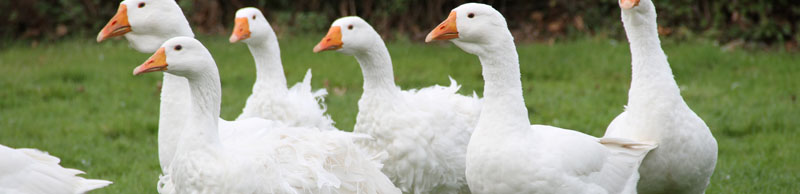
Pilgrim and other auto-sexing geese: Normandy, WoE and Shetland
Auto-sexing characteristics appear most strongly in three breeds
of geese now standardized in the UK: the Pilgrim,
where the female is completely grey apart from her stern and
distinctive white spectacles; and the Shetland and
West of England, where the female displays a typical grey
saddle-back pattern accompanied by grey thigh coverts and head. In
these breeds the accompanying gander is mainly white. These
auto-sexing breeds are most probably derived from what Harrison Weir
calls the ‘Common goose’: ‘the ganders are invariably white; and
that even if the geese are grey. But this may be and is perhaps
attributable to centuries of selection as to colour’.
Similarly marked geese are also documented from France. The
Normandy and the Bavent are the best
known, and are marked as the West of England. They are recorded in
France in references from the early 1900s (in
Keeping Geese).
Birds of these types also went with emigrants to Australia
and North America, so these continents also have auto-sexing geese.
Their distinctive nature was recognized by the American, Oscar Grow,
who, in a letter to Paul Ives, said that they were very common in
New England and that he had taken the ancestors of his flock from
Vermont. The birds were thought to have been a part of the Pilgrim
Fathers’ stock when they first reached Cape Cod, yet there seems to
have been little evidence for this supposition. Oscar Grow
maintained that he named the birds ‘Pilgrim’ after the family’s
removal or ‘pilgrimage’ from Iowa to Missouri during the 1930s Depression. The breed was recognized by the American Poultry Association
in 1939.
Robert Hawes has determined that geese were probably not aboard the
Mayflower itself, nor on the second ship Fortune. The birds may have
come to America by various routes: independent flocks have been
found in Connecticut and Alabama, the latter with perhaps a French
connection.
In the twentieth century, knowledge of the Common Goose was all but
lost as the fancy imported breeds became more popular in the show
pen. The Embden and Toulouse outclassed the Common goose. However,
the birds did survive in the farmyards of Britain, Normandy,
Australia and the USA.
In Australia, the Settler goose (named by Andreas
Stoll in 1984) is their equivalent
of the Pilgrim. In the USA, the Cotton Patch goose
also carries the same colour genes as the West of
England/Normandy/Shetland.
Description of the Pilgrim
Pilgrims are medium weight geese (12-18lbs). The ganders are nearly
white, some of them having faint grey plumage on the back, wings and
tail. The females are pale grey, not the harder grey of a Pomeranian
or Toulouse. Associated with the sex-linked colour is the paler
face. Young females may have a grey face, but white feathers advance
with age and form 'spectacles' around the eyes. The photographs show
adult females with white extending over the front of the face.
In a pure strain of Pilgrim geese, the goslings are auto-sexing.
This means that the sex can be determined by the colour of the fluff
as goslings, and by the feathers as adults. There is not a great
deal of difference at first, but new fluff grows as the gosling
becomes bigger. The males are distinctly whitish by 12-14 days, and
the females are grey. The best way to distinguish the sexes at
day-old is by bill colour. The females are darker.
Most strains of Pilgrims, hand reared, are exceptionally tame. They
have a lovely temperament and are well worth keeping as pets. Oscar
Grow comments on their being a sweet-natured breed. They are also
very self-sufficient if left to their own devices - good grazers
with a strong flocking instinct.
The origin of sex-linked colour
The Pilgrim breed probably evolved over a long
period of time through people traditionally selecting a white gander
and a grey goose as a breeding pair from farmyard stock. This
happened in Britain and France. Of course, birds of the same type
went to Australia and North America, so these continents also have
auto-sexing geese.
F.N. Jerome’s work on colour genetics in USA geese during the 1950s
gave a better understanding of the breeding characteristics of the
Pilgrim. He concluded: ‘It appears that the adult shades of the
Pilgrim breed in which the male is white and the female gray
(dilute), result from the interaction of the sex-linked dilution
with the solid pattern of dark gray [the wild colour] . . . It is
postulated that one gene for sex linked dilution reduces the gray of
the female to dilute gray and that the additive effect of two genes
for sex-linked dilution reduces the dark gray of the male to white.’
Pilgrim geese therefore carry the sex-linked dilution gene, but not
the autosomal spot gene.
We now know that, in addition to [Sd], modifier lightnening genes
are also needed to ligjhten the ganders.
The colour of the West of
England/Shetland/Normandy is more of a mystery. The ‘spot’
pattern is there in the colour pattern of the female. She has white
‘spotting’ in the flights, neck and breast area, leaving diluted
grey feathers in a saddleback pattern, and grey feathers on the
head.
This pied pattern is not apparent in the adult male plumage (it is
only seen in the fluff). Normally, white spotting (sp) plus dilution
(Sd) turns both male and female geese white, as it does in the Czech
and Embden. In the case of the WoE, the adult goose retains the
dilute grey colour in a saddle-back pattern. Rather than ‘spot’
itself being modified, we now believe that the effect of dilution is
modified in auto-sexing breeds. This allows the pied pattern to show
up despite the dilution (termed Sd#). In the case of white breeds,
more complete, intense dilution (Sd) hides the pied pattern in the adult
plumage.
Further details were published in Liz Wrights’
Magazine ‘Smallholder’
November 2021:
Auto-sexing Pied Geese : Conclusions - Auto-sexing with spot
(sp) plus limited dilution (Sd#) could have been the norm for flocks
of European geese for centuries. Further modifier action on dilution
(Sd) could then ‘whiten’ Roman and Embden geese, which have long
been selected for their white feathers and down. Columella, writing
in the first century A.D., urged breeders to choose males and
females of ‘the largest possible size and of a white colour’. It has
simply been a matter of selection of the ‘whitest’ birds. Although
‘white’ breeds still retain ghost pied markings in the infants,
these areas have been reduced in colour intensity.
Further breeding research is being carried out in both the USA and
UK, and anecdotal evidence and initial breeding results this year
(2021) have confirmed that limited dilution (Sd#) is the key to pied
auto-sexing. It also explains why sex-linked characteristics can
easily be lost by cross breeding with white geese which have normal
(Sd). If you want reliably auto-sexing birds, they must come from an
authenticated, established flock unless you are willing to test
breed them yourself.
More details of the history and genetics can be found in 'Keeping
Geese' and in this
article:
More info on how autosexing
in geese works


 Normandy at 5 weeks